Beyond the Fragmented Tech: Reclaiming Your Digital Sovereignty
There is a landscape most women doing sacred work know intimately, even if they have never named it.
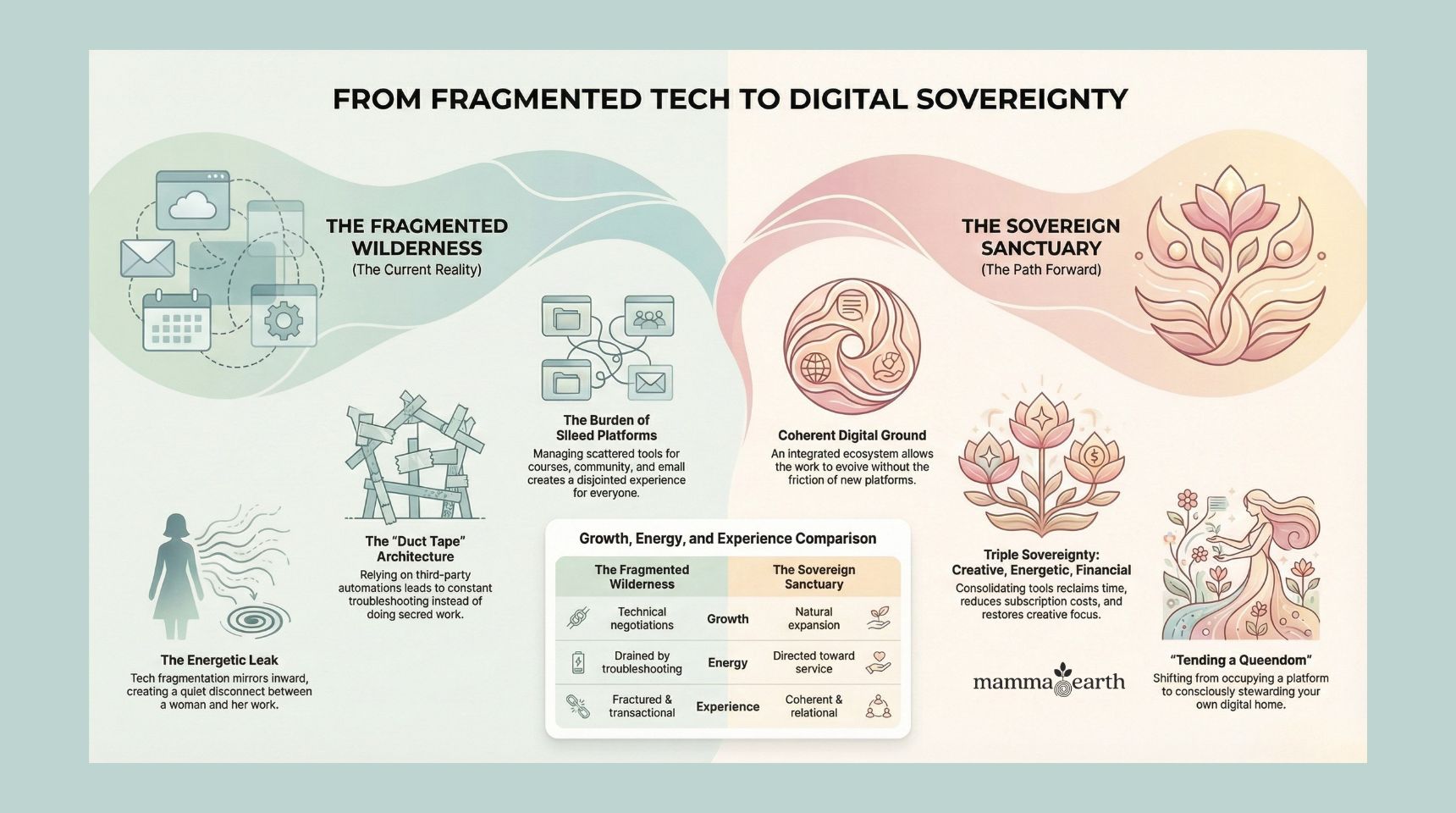
It is a landscape of scattered platforms — courses hosted in one place, community held in another, bookings managed through a third, email marketing running on a fourth, and a website sitting somewhere else entirely, built years ago on a system that no longer reflects the depth of the work it was meant to represent.
This is the fragmented digital landscape that every practitioner inherits. Not because she chose it. Because this is how the technology evolved.
How We Learned to Build in Fragments
Big tech did not evolve as an ecosystem. It evolved in silos.
One company built the best course platform. Another built the best email system. Another focused on bookings. Another on community. Another on websites. Each solved one problem beautifully — and each required its own subscription, its own login, its own language, its own learning curve.
The promise was integration. Connect them with third-party tools. Automate the bridges between them. Make them talk to each other.
The reality is duct tape.
Every growth stage — from the first offering to a full body of teaching — requires re-entering what might be called the tech wilderness: the territory where you stop doing your sacred work and start troubleshooting connections between platforms that were never designed to live together.
Each new threshold costs time, energy, and money. And each time, you emerge a little more fatigued, a little more resigned to the way things are.
This is not a personal failing. It is a structural inheritance. The architecture of the online world built for transactions, not for the kind of relational, embodied, living work that women hold.
And the fragmentation does not stay external. It mirrors inward.
As the digital world evolves at a pace no human nervous system was designed to match, the pressure to keep up quietly reshapes how a woman relates to her own work. There is always a new platform to learn, a new feature to integrate, a new expectation of what a professional online presence requires.
The ground is always shifting.
And so she builds the only way the landscape has taught her — one more tool, one more bucket subscription, one more bridge between systems — because this is all she has known.
She builds in fragments because the world she is building inside is fragmented. And with each addition, the distance grows — between the expression of her work and the living root it grew from.
The course does not quite carry the voice of the community. The emails feel different from the experience of being in the room. Each piece is functional. None of them, together, feel like her.
This is the cost that is rarely named. Not just the financial cost, not just the hours lost. The quiet widening of the space between a woman and the coherent centre of her own sacred work.
The Familiar Wilderness
There is a particular pattern that emerges once a woman recognises her digital landscape is fractured — and most women recognise it long before they act on it.
She stays.
Not because she believes the current arrangement is working. She stays because the familiar territory, fragmented as it is, requires less energy than navigating the unknown. She has already invested time learning each platform. She has already wired the connections between them, however imperfect. She has already trained her team and her clients to move between the scattered rooms of her digital house.
The cost of starting again — learning a new system, a new language, migrating content, rebuilding pathways — feels like a weight she cannot carry alongside the work itself.
And so she adapts. She adjusts her workflow around the limitations. She accepts the chaos and confusion her clients experience and that her energy will continue to leak into the gaps between systems that were never designed to hold what she carries.
This is the familiar wilderness — the paradox of staying in a landscape that is known but not coherent, because the coherent ground feels impossibly far away.
What is rarely named is this: the familiar wilderness is not a neutral place. It compounds. Every month spent managing fragmented systems deepens the fatigue, widens the gap between the woman and her work, and quietly reshapes her relationship with her own clients — because she is asking them, too, to navigate the fracture.
The sacred work she is devoted to — work that is designed to restore, reconnect, and bring people home to themselves — is delivered through infrastructure that fragments the very experience it offers.
The Threshold That Is Not About Technology
Beneath the practical resistance — the time, the energy, the learning curve — there is a deeper threshold.
It is not a technology decision. It is an identity-level shift.
Leaving the familiar wilderness means stepping into authorship of the entire digital ground your work stands on. Not just choosing a new tool. Claiming responsibility for the architecture itself — the way your clients arrive, the way they move through your offerings, the way your work is held and presented and experienced as one coherent body.
This is what digital sovereignty actually means.
Not independence from technology, but conscious stewardship of the ground your life work grows from. A woman who takes this step is no longer managing a scattered collection of platforms. She is tending a queendom — a living, breathing, integrated home for everything she has built and everything she is becoming.
Robin Wall Kimmerer writes about the difference between a landscape that is simply occupied and one that is tended with reciprocity. The same distinction lives here.
A fragmented tech landscape is occupied — she exists within it, works around its limitations, makes do.
A sovereign digital sanctuary is tended — designed with intention, built around the shape of her specific work, alive with the same care she brings to the people she serves.
The shift asks something real. It asks her to see the whole of what she has built — not platform by platform, but as a complete ecosystem.
It asks her to believe that her work deserves coherent ground. And it asks her to step into a new relationship with the infrastructure that holds her life work — not as a necessary burden, but as sacred ground that is hers to steward.
What Becomes Possible on Sovereign Ground
A woman standing on coherent ground does not begin her day in the gaps between systems. She begins in the roots of her work.
This is where growth changes shape entirely. When the infrastructure holds, growth is no longer a series of technical negotiations — finding the next platform, learning the next integration, paying for the next subscription to solve a problem the last one created.
Growth becomes what it was always meant to be: the natural expansion of a body of work that is alive, rooted, and ready.
A new programme does not require a new platform. A deeper level of client care does not demand another tool. A course that wants to become a school, a practice that is ready to become a training — these unfold within the same ground, because the architecture was designed for the work to evolve, not for the technology to dictate what evolution is permitted.
This is creative sovereignty — the freedom to shape your offerings, your content, your client pathways, and your public presence from your own vision, not from the limitations of whichever platform you happen to occupy.
When a woman is no longer building inside someone else's template, her creative intelligence leads. The work takes the form it was always reaching toward.
And with creative sovereignty comes its energetic counterpart.
The quiet, relentless drain of managing scattered systems — the cognitive load of remembering which platform holds what, the low-grade anxiety of things not quite connecting, the hours lost to troubleshooting that could have been spent in service — that drain ceases.
Not because she has become more efficient, but because the architecture no longer requires her to compensate for its fractures. Her energy is no longer the bridge between disconnected systems. It is hers again, fully, to direct toward the work and the people the work serves.
Financial sovereignty follows the same current.
Multiple subscriptions become one — and the resources that were scattered across platforms, each taking their cut and offering their own terms, return to the woman who earned them.
What once flowed outward to sustain someone else's ecosystem can now be directed toward the tending and growth of her own — toward the design that serves her clients better, the stewardship that keeps her ground alive, the creative expansion she has been deferring because the budget was already consumed by infrastructure she never chose.
She sees clearly what her work generates, where value circulates, and how her resources are being stewarded — because the entire financial life of her practice now lives in one place, under her oversight, on her terms.
These three — creative, energetic, financial — are not separate freedoms. They are one sovereignty, experienced in three dimensions. And together, they change what a woman is able to create in the world.
Because when the ground holds, she does not simply maintain what she has built. She expands. She reaches toward the women she has not yet served, the teachings she has not yet offered, the collaborations she has not yet entered. The impact of her work is no longer contained by the infrastructure — it is carried by it.
A healer whose sanctuary is coherent can welcome a client from the first point of contact through an entire arc of care without a single moment of friction.
A teacher whose school lives under one roof can steward a student from first module through certification and into their own practice — with the pathway clear and whole.
A guide whose community, teachings, and communications breathe as one organism can create the kind of lasting, generational change that fragmented systems simply cannot hold.
This is what ownership looks like when it is not a burden but a devotion.
She is not managing technology, she is stewarding a living ecosystem — one that reflects her values, serves her people with integrity, and grows as she grows.
The responsibility is real. And it is hers.
Not outsourced to multiple different companies with multiple different visions of what her work should look like, but held in her own hands, on ground she has chosen, in an architecture that was designed for exactly what she carries.
The Remembering
Every woman who has crossed this threshold — from the familiar wilderness into sovereign ground — describes something similar. It is not the relief of having fewer logins. It is the remembering of why she began.
When the infrastructure holds, when the pathways are clear, when the technology breathes with the same rhythm as the work it carries — something returns.
A clarity.
A steadiness.
A spaciousness that had been so gradually consumed by fragmentation that she had forgotten it was ever hers.
The digital landscape she inherited was never designed for what she holds. But the landscape she chooses — the ground she consciously tends — can be.
There is sanctuary for work like yours. Ground that was designed for the depth and complexity of what you carry. A conversation is a gentle place to begin.